by John Wijngaards
from MISSION TODAY, Summer 1995, pp. 12 – 13.
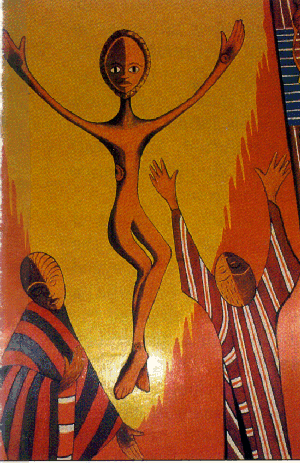
AFTER the Good Friday liturgy I was asked confidentially whether the crucifix we use is true to Scripture. The enquirer had learned in school that Jesus died naked on the cross.
Actually, it is not easy to establish with certainty what happened at the crucifixion of Jesus in this regard. The apocryphal Gospel of Nicodemus states that Jesus wore a loincloth (Nicod 1:10). This Gospel, however, was written centuries after the event. It is not reliable. It takes its description of the crucifixion from a pious but legendary source, the so-called Acts of Pilate, which was composed towards the end of the second century.
Some scripture scholars believe that wearing a loincloth may have been a special concession the Romans had given to the Jews to spare Jewish sensitivity. Offering a pain-killing drug before the crucifixion may have been another such concession. Jesus was offered one, but he refused to drink from it (Matt. 27:34; Mark 15:23).
However, we have no independent confirmation of such a concession regarding nakedness. The four Gospels give the impression that the soldiers took all Jesus’s clothes and divided them as loot.
How did the Romans treat those who were crucified? Contemporary writers, such as Artemidorus and Arnanus, have left descriptions that imply that the unhappy victims were, indeed, left totally naked. Some of the Fathers of the Church, such as St Cyprian and St Augustine meditated on the nakedness of Jesus in words that show they were convinced that total nakedness was one of the humiliations inflicted on him. Weighing the evidence I believe that, in all probability, Jesus did not wear a loincloth on the cross.
Understandably, we avoid extreme realism in our crucifixes and other representations of the passion. But this should not make us forget the horrors of the crucifixion. For our sake, Jesus gave up everything he possessed, as Paul says (Phil 2:7). Next to all the physical pain, Jesus also suffered the excruciating humiliation of being publicly exposed, naked and vulnerable, on a “pillar of disgrace”. Is that in itself not worth a meditation and a word of thanks?
But then it may also be important to consider nakedness itself. Because of our Victorian and Puritan past, we still have traces of anti-body feelings in our spirituality. I remember a nurse once telling me that, while she was giving a Catholic patient a bath, this person said to her: “Sister, it must be hard for you to be seeing so much sin.”
“What do you mean?”, she asked.
“Well, touching the body and all that.”
The remark probably hid a complex of incorrect notions: as if any part of our body is less holy and honourable; as if our sexuality is only tolerated by God as a lesser evil; or, as I heard from some people, as if original sin is transmitted through sexual intercourse. Just imagine: the most marvellous bond in the world through which a married couple cooperates with God’s creation was seen as a channel of sin!
In our culture, in which sex is discussed much more openly and in which nudity at the same time is often exploited by the media for commercial purposes, we find side by side the old Puritan shame of the body, an unhealthy preoccupation with sex and the search for a responsible freedom. In our time it is essential that we re-state our Christian convictions about the body.
The human body is beautiful. There nothing in it that is sinful, or of which we need to be ashamed. The body even retains its dignity and beauty when people grow older. In Jesus’s time people were much more natural about this than we are. Peter was naked when working in his boat (John 21:7). The Greeks and Roman practised their sports without clothes on. The Greek word gymnos meant “naked”. We still find the word in such terms as gymnastics and gymnasium.
We can be shy about nakedness in a healthy and prudent way. But we may also have inherited a false shame about our naked body; like Adam and Eve who, after their sin, suddenly discovered that they were naked (Gen 3:7). In a good Christian education we should be helped to discover the true beauty of the human body and sex. It is precisely because of our deep respect for the body, which is a temple the Holy Spirit, that we will then avoid making it merely an instrument of pleasure (1 Cor 6:18-20).
I find the nakedness of Jesus on the cross meaningful in that context. In his body Jesus carried all scars of our world, including our sexual searchings and aberrations. He redeemed us, and through his risen body enables us to carry our own body with a renewed sense of happiness a respect. “This is Me, this is my body”, says to us, as we receive holy communion. His passion, his humiliation, but also his resurrection then flow into us.