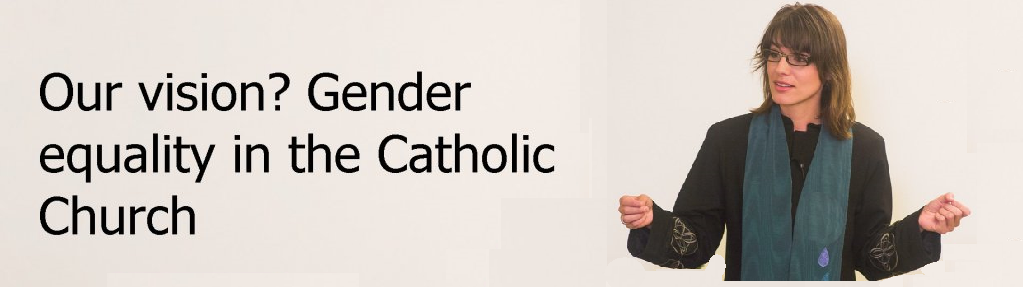
Soline Vatinel told her vocation story at a seminar on women’s ordination, organised in Dublin on the 25th of March 1995 (See Women – Sharing Fully in The Ministry of Christ?, BASIC 1995, pp. 39-45). She is a Founder Member of the Irish Catholic women’s ordination campaign: B.A.S.I.C. (= Brothers and Sisters in Christ).
Here republished on www.womenpriests.org with permission of the author and of BASIC.
Origins

I am French, born in 1956 into a Catholic family. It was my mother who was the person of faith, my mother who fell ill when I was seven with cancer and died when I was twelve. In between, when she was well enough, she was parish catechist and I remember children coming and sitting round our dining room table and drawing pictures of the gospel and my mother explaining to them the gospel.
Her death when I was twelve years old was a profound experience and it did challenge my faith. Up to then I believed that God’s love protected from suffering. When I saw my mother’s coffin going into the grave, I did wonder where was God, and the words of Martha came to me. (I was brought up on the gospel more than on the catechism and I am grateful for that.) The words which came to me were ‘If you had been there, my mother would not have died’.
It took me a few years by which time I was an adolescent, to come to terms with her death. Two years later I adopted for motto a line from St. John’s Gospel and I am glad I did because it has sustained me ever since. The words are those of Jesus to the apostles,
‘In the world you will have troubles but be of good cheer. I have overcome the world’.(John 16:33)
My mother’s dying also meant long summer holidays and a father who did not know what to do with his daughter. I have one older brother. It just happened, coincidence or ‘God-incident’, that somebody was going to Ireland taking some students. I arrived for the first time in Ireland, in Tullow, County Carlow in the summer of ’69, the year of the ‘Troubles’. I think it was a broken girl who fell in love with a very broken country.
My vocation
I loved Ireland so much that I came back every summer. When I was taking my final school exams I had long decided that I would come and study in Ireland. I came in 1973 to study history in Trinity College, and I am still here 22 years later!
I had a lively faith as a youngster and I had been quite involved at school with groups of students, reflecting on the gospel. I was also still very much a carefree child, full of the excitement of studying in a foreign city, although quite shy.
At the end of my first year at college, I had an experience which, though it happened over twenty years ago, will remain with me forever. It changed the course of my life. It was a profound experience of God as love, not in the intellect, not in the mind, it was real, I was flooded with love. That is the only way I can describe it and I think it is also an understatement. An overwhelming awareness of God’s love, not just for me but for the whole world and out of that the question of how to respond to such a tremendous love. I could not keep it to myself: it had to be shared.
And then very quickly, the sense of being called to the priesthood came. It was very disturbing. I had not been brought up with the idea of women being priests and I had never challenged it. I had never wanted to be an altar girl. I had accepted that God called men to the priesthood; God called people to different things. I did not see my life in terms of the priesthood and when the calling came I think it brought me to the verge of – and it is not too strong a word – insanity.
I spent some time in St. Patrick’s Hospital and later I ended up in the casualty department of Jervis Street Hospital with an overdose. It was the college chaplain who brought me there. It was a deep cry for help to try and understand something which nobody could help me understand. The chaplains were very friendly, good men, and I am very grateful to them for what they did in the four years I was in college and later. But the concept of a woman called to the priesthood was just not on and I was struggling on my own with something which I could not reconcile with my view of myself.
It was a very lonely struggle and what I remember of those years is the prayer ‘Do not call me; your Church does not want me’. I did not have the faith of Mary of Nazareth who could say ‘Yes’ to the impossible. The Church did not want girls like me so I did not want God to call me. I did not have any theology at the time although for part of my history course, I studied the Reformation. That was how I got into theology and I struggled with that as well.
Four years to come to terms – I won’t go into the depths of it. There was also a pilgrimage to Assisi; I think St. Francis helped me along the way. My faith remained; that in itself was a miracle. I was a daily Massgoer and I think the Eucharist saved my life. More than my faith, my very life.
Violence inflicted by the Church
Jackie Hawkins has talked about priesthood as a baby, a baby who was perhaps miscarried or whom the institution would want to abort. I do not think it is too strong to talk about calls to the priesthood being aborted in women. It is the life of God planted in women’s hearts which is being aborted. It is violence of the worst kind. It is not visible and therefore it can be ignored and when it is spoken it is being silenced.
That call remained with me through marriage, a very happy marriage to Colm, and two fine children, two sons who are being cared for today, during this seminar, by a very kind mother-in-law. But the calling to the priesthood never went away. It went underground; it went deeper. I studied theology and ministered as a marriage counsellor, never fulfilled. I never fulfilled my call. It grew deeper and stronger.
Every year when there was a call in Church on Vocations Sunday appealing for priests it was like a wound being reopened. We have a Church appealing for priests but not of the wrong kind, the female kind.
Then in 1990, it just was too much. The baby was alive and kicking and wanted to be born. It had not been aborted but by the grace of God was still there. And in 1990, in great pain, but birth is never easy, that baby came forth.
It did surprise me and it surprised the ones who were with me – Colm and Eamonn, who had been one of the chaplains in Trinity and was still with me. It came out in great pain with days and weeks of weeping with the pain of being stretched just as the woman is stretched at birth. It stretched my heart. I had to say yes to something that was very big and I was a very small person. Yet it came forth and it came alive.
It was not the end of the pain. After that it had to be spoken; it had to be shared with neighbours, friends, with bishops, people in power. There was more pain and I suppose a real encounter with the cross.
I will share with you now a short poem that I wrote about three years ago –A woman of sorrow – talking about that pain.
The actual context of it is this. I was listening as a friend to a young girl who had been sexually abused by an older brother and who because of it has spent most of her life since – I suppose over ten years – in St. John of God’s hospital coming to terms with a very deep violation of who she was.
Listening to her, her pain and sense of violation resonated very deeply with me. I have not been sexually abused but I have been profoundly spiritually abused by my own Church, the Church whom I deeply love. I am grateful to her for putting me in touch with that experience.
At the time that I wrote the poem I had been told to write my story. I tried, starting with the beginning, going through childhood but I could not. It was too painful and I could not speak about it. But the poem came and that was all that came out.
A Woman of Sorrow
An object of curiosity or rejection,
she hangs,
bloodied and bruised,
stripped of her dignity,
crucified on the cross
of her calling.
Above her head it is written:
“Woman priest”
The blind crowd jeers and mocks,
spitting God, Scripture and Tradition
to her face
‘God chooses only men’.
‘You’re a neurotic, get your head examined’.
‘You lack humility, you want power’.
If only she would recant,
confess her deluded arrogance.
Many turn away,
a few stand by her.
For eighteen years now
she has been bound
her womanhood derided
her youthful life ebbing away
in an endless agony.
Only silence answers her screaming broken heart
Church – forsaken
God – forsaken.
Through her tears
she sees Him at her side
the loving, gentle Christ
who called her, still a girl
to serve Him.
Bloodied and bruised,
crucified on the cross of His calling,
and yet smiling:
‘Woman, they did not receive Me,
and so they do not receive you,
for they do not love enough’.
The poem was to have been published in a Catholic magazine last year but after the Pope’s letter the editorial board said no.
Evidently that pain is too disturbing to be spoken.
Women who are crucified
With the poem I painted an image with my children’s paints, but all that came out was black. I painted a woman upon the cross. She is naked just as Jesus was naked upon the Cross. I was studying here in Milltown and I put it up on the notice board. It was taken down. Nothing more obscene than a woman hanging on the cross.
Later, I talked to the Archbishop of Dublin about my sense of calling to the priesthood. I had not mentioned the word cross but he mentioned it and said to me ‘Only a man can be on the cross’.
There are many women crucified, like that woman who is still in St. John of God’s. There are many ways of suffering and Mary at the foot of the Cross was on the Cross with her son. This is a pain that the Church does not want to hear about because it asks profound questions.

I will finish not with my own words but with the words of a woman who was not crucified but shot in a small village in Peru, four years ago. She was a religious sister, Sister Irene McCormack and in last Saturday’s Irish Times, they remembered her public trial and execution by the Shining Path.
A witness to women’s ministry
A few months before she was shot dead she wrote a letter which has been published. There were no priests left in that village. She was the one left behind, the one who had chosen to stay with the people whom God had entrusted to her. She was baptising and celebrating with them but there was no Eucharist. They came to her, those Peruvian people and they said ‘Give us the Eucharist’. She did not want to. She was not ordained, she was a woman and God did not call women but then she realised and she wrote: ‘They freed me to exercise Eucharistic ministry among them’. I quote from her:
‘Our preoccupation with the only reality being the scientific, the empirical, makes it hard for us to accept the validity of symbolism. Not only is it a contradiction to the proclamation of Jesus that there is no distinction between male and female, but a lack of appreciation of the plight of villagers like ours all over the world that our Church continues denying its official ministry, that is by nature ‘communion’. As we in our little Christian communities high up in the Andes, gather in memory of Jesus, there is no power or authority on earth that can convince me that Jesus is not personally present.
I feel grateful that these months on end without the ‘official Mass’ and in a culture where I am experiencing new symbols have gifted me with a new appreciation of Eucharist.’
From: Compass: A Review of Topical Theology, Vol. 25(4) 1991 pp.33-35.
Irene McCormack did die. She shed her blood after giving the blood of Christ to these people whom she loved.
I am very grateful that you are willing to listen to those voices that have been silenced. BASIC was born out of immense pain but also out of the compassion of two men, a priest and my own husband, who saw the pain and did not shy away from it.
25 March 1995
UPDATE
After 9 happy years, I stepped down from the BASIC core group at the AGM last April . And I am no longer seeking ordination for myself : “God has been gracious to me.
Soline Vatinel
June 24th 2002, feast of Saint John the Baptist
| ||||||
Six options for Catholic women who feel called to the priesthood? |
Please, credit this document
as published by www.womenpriests.org!