by Malagoli
This article orginally appeared in Conscience, published by Catholics for a Free Choice, Spring (2003) p. 35; republished here with permission of the artist and publisher.
MALAGOLI is a Belgian artist and a professor of pictorial art. Her drawings on religious themes are regularly published by the French Catholic monthly review Golias and she has had exhibitions in Belgium and France.
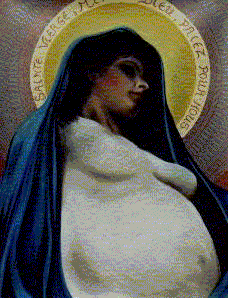 |
| The Pregnant Virgin ©Malagoli, 2002 |
SINCE JESUS WAS BORN OF A WOMAN, a woman was pregnant with Jesus.
For this woman, the pregnancy must have been what it is for every woman: a world. A world of feelings and thoughts. A succession and crisscrossing of moments of glory and moments of doubt, times of courage and weariness. An experience where the feeling of being inhabited by a mystery gives way to the prosaic reality, where the physical reality of the pregnant body magnifies to a mystical elevation.
Mary’s pregnancy must have been all of this. It must have been more than this, due to the Annunciation. How does one believe that the Annunciation put Mary’s pregnancy above all others as a sort of “angelic” pregnancy? The son was exposed to temptation and doubt. How can one believe that his mother was spared these trials? The Annunciation did not simplify Mary’s pregnancy. It most likely complicated it, and at least intensified it.
The pregnancy of the Virgin: a sublime, but also worrying experience. A subject, that at first glance is susceptible to stimulating artistic inspiration.
So where, in religious icons, do we see a representation of the pregnant Virgin? We go from the Annunciation to Mother and Child, from the announcement of a child to the child already being born. So where is the mother carrying this child and preparing for it to be born? Where is the woman carrying the Word made Flesh, her flesh?
What obstacles, what inhibitions, what embarrassments prevented the representation of this theme? If it involves censorship, it’s surely censorship in a quasi-psychoanalytical sense: not a prohibition from expressing what we think or imagine, but inhibition of thinking or imagining.
If there was this prohibition in the past, there are reasons that might explain why. These reasons are linked most notably to the social status of women.
But how does one explain why even today, as soon as one presents to the public — as I have done —a work representing the pregnant Virgin, one is met with reactions of surprise, unease and scandal? At least, once one manages to show it, notably in a private gallery. Because, if one plans on showing this piece in an open space —a cultural center, the foyer of a theatre, a business —one runs the risk of being rejected by those in charge (not necessarily people of faith, by the way) who say they are scared of offending the “religious sentiments” of the public. As if it were a blasphemous theme…
There are also perhaps explanations that call upon the imposed, normative nature of religious iconography. These explanations still leave the following unexplained: That a religion that believes in the Word made Flesh prohibits itself from imagining and representing this flesh that welcomed the Word.