
from the Legenda Aurea (13th century) by Jacopo di Voragine. See Mary Magdalen. The Saints in Legend and Art, vol.5, by J. H. Emminghaus. Text of story and legend by Leonhard Küppers. Aurel Bongers, Recklinghausen 1964.
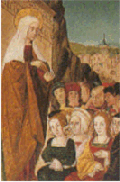
This ‘life’ was extremely influential in shaping medieval devotion to Mary Magdalen. In 1260 Jacobus de Voragine, an Italian dominican, wrote a standard legendarium, the Legenda Aurea. The genre of these hagiographical compendia was not new, but the order that Jacobus brought to the large number of rival vitae and legends that had up to then been haphazardly available, that order was certainly new. The hunger for storytelling will certainly have contributed to the great success of this legendarium. In the Legenda Aurea, as in the other legendaria, elite sources and popular stories are welded together and theological speculations about Mary Magdalen are reconciled with popular devotional practices.‘The literary and the iconographic image of Mary Magdalen’ by R. Baert, Alma Mater Magazine.
“Mary Magdalene has the name Magdalene which was originally a fortress (Magdalum). She was of noble birth, in fact of royalty. Her father’s name was Syrus, her mother’s Eucharia. She, her brother Lazarus and her sister Martha owned the castle two miles from the Sea Genezareth as well as the village of Bethany near Jerusalem, plus a considerable part of the city of Jerusalem, but they distributed their treasures so that Mary Magdalene owned the castle which also appears in her name while Lazarus owned part of Jerusalem and Martha Bethany. Since Magdalene became a woman of the streets and Lazarus a knight, Martha took care of the possessions of both and she reigned over them with prudence. Martha cared for all her warriors, servants and for the poor. But when the Lord died they sold all of their belongings and donated the money from the sale to the Apostles.”
“Magdalene was extremely wealthy and bodily pleasure is always an associate of wealth. As she saw her beauty and her wealth she fulfilled herself in nothing but bodily pleasures. As a result, she lost her good name and was simply referred to as the sinner. When Christ preached in the country she came—by God’s providence—into the house of Simon the leper for she had heard that Christ was going to eat there. Not daring to sit among the just because she was a sinner she walked straight up to the Lord, washed His feet with her tears, dried them with her hair and anointed them, for it was the custom that the people used ointments for the heat of the sun was great. Simon the Pharisee thought ‘If this were a prophet he would scarcely allow himself to be touched by a sinner.’ But the Lord punished him because of the superficiality of his justice and forgave the woman for all her sins.”
“This is the Mary Magdalene upon whom God bestowed such great grace and to whom he made evident so many signs of love. He expelled seven evil spirits from her and inspired in her the love for Him. He made her a special friend, a great hostess and a help on His road. He excused her at all times with great love, defended her against the Pharisee who had called her impure, against her sister who had accused her of idleness, and against Judas who had called her a spendthrift. And whenever He saw her weeping He wept, too. The Lord loved her so much that He awakened her brother from death even though he had been in the grave for four days, and He cured her sister Martha of hemorrhages that had made her suffer for seven years. Out of love for her He blessed Martilla, the maiden of her sister that she raised her voice and said the sweet words of St. Luke 11, 27 ‘Blessed is the womb that bare thee and the paps which thou has sucked.’ For when Ambrose spoke the hemorrhaging woman was Martha and the woman who spoke these words was her servant. However, Magdalene was the woman who washed the Lord’s feet with her tears, dried them with her hair and anointed them with ointment. In the time of grace she did her first penitence. She elected the best part, she sat at the feet of the Lord to hear His word, she anointed His head, she stood near the cross when He died, she prepared the ointment for His corpse, she did not leave the grave when the disciples did leave the grave. She was the one to whom the Lord appeared first when He was resurrected and she was the woman whom the Lord made the Apostle of the Apostles.”
“When our Lord ascended to heaven after His sufferings in the fourteenth year, when Stephanus had long before been stoned by the Jews and the other disciples had been expelled from Judea, the disciples went into many lands in order to spread the word of God. With these apostles was Maximinus, one of the Lord’s seventy–two disciples to whose guardianship St. Peter had commended Mary Magdalene. When the disciples were scattered St. Maximinus, Mary Magdalene, her brother Lazarus, her sister Martha with her servant Martilla and Cedonius (who was born blind but who had been cured by the Lord) and many other Christians were gathered on a ship by the heathens which was then pushed into the ocean so that they would all perish. By God’s providence, however, they arrived in Massilia. They found no one who wanted to give them hospitality and therefore remained in the vestibule of the heathens’ temple.”
The Legenda Aurea then tells us how Mary Magdalene induced a prince to put them up in his house; how she made it possible for the wife of the prince to become the mother of a son; how the princely couple made a pilgrimage to Rome and Jerusalem; how the princess died on the ship while her son was born, and how the dead princess was returned alive to the prince and his son by the miraculous help of Mary Magdalene. Then the Legend continues:
“Mary Magdalene desired meditation and went into the forest wilderness where she lived incognito for thirty years in a place prepared for her by the hands of angels. In this place there were neither fountains nor trees nor grass. This indicates that our Lord did not want to sustain her with earthly food but with heavenly nourishment. Every day she was led to the heavens by the angels—seven times for the seven hours of prayer—and with her own ears she heard the chants of the heavenly hosts. And every day she was taken back to earth with this sweet nourishment so that she never needed earthly food.”
According to this legend Mary Magdalene died in Aix in Southern France and was buried there by the Bishop Maximinus. Some of her remains later were taken to the French monastery of Vezelay, the church of which carried her name. The Legend continues
“In the time of Charlemagne, approximately in 769, there was in Burgundy a Duke called Gerhard. His wife bore him no son. He therefore gave all his belongings to the poor and built many churches and monasteries. When he founded the monastery of Vezelay he and the abbot sent a monk with a worthy following to Aix and commissioned him to bring the remains of St. Mary Magdalene to Vezelay. The monk found that Aix had been completely destroyed by the heathen. However, he found a tomb hewn entirely from marble and the tombstone indicated that St. Mary Magdalene was buried there, and in fact her history could be read because it was chiselled into the stone. When night came he opened the grave, took the remains and brought them to the place where he stayed. And it was then that Mary Magdalene appeared to him that same night saying to him that he should not be afraid but should complete the work which he had started. The monk started home but one mile before he had reached the monastery it seemed that the remains became so heavy that he could no longer carry them. Then the abbot with the monks of the monastery appeared in solemn procession and they all took St. Mary Magdalene’s remains to their domicile with the greatest of honors.”
According to the Legend,the adoration of St. Mary Magdalene in the French monastery of Vezelay was accompanied by many miracles. She is supposed to have awakened a dead knight to life, to have aided the sailors, to have returned vision to a blind pilgrim when he had asked her for help in front of the church of Vezelay. She is supposed to have released a prisoner from chains and to have shown the path of virtue to a sinful priest. No wonder, then, that a Saint so generally worshipped was offered many patronages. The cities of France in particular, such as Antun, Marseilles and Vezelay, looked upon her as their patron saint. In fact the whole Provence respects her as such. She is also the patron of the coiffeurs, gardeners, winegrowers, sawers and weavers. Mothers turn to her when they pray for their children who find it difficult to learn how to walk. Above all, of course, she serves as the great model for all sinners eager to convert to virtue.