John Wijngaards, Mount Carmel 45 (1997) no 3, pp. 18-25.
On October 19, 1997, St. Thérèse of Lisieux was officially declared a Doctor of the Church. Although the Roman authorities may not have realised this, their recognition of Thérèse’s orthodox faith and soundness of teaching has consequences for the ordination of women. For St. Thérèse had a profound longing to be a priest and so, implicitly, gave testimony to her deep ‘Catholic sense’ that women can and should be ordained.
The Congregation for Doctrine has for the moment pronounced its verdict against the ordination of women to the priesthood. The three principal theological reasons it has given for this decision are: Christ only chose men to be his Apostles. Because Christ was a man, a masculine priest represents him better. The tradition of the Church in past ages has always been to ordain only men.
Most theologians would not agree that these are valid reasons. But where theologians, for the moment, ponder how to respond best to Rome’s public stance, many committed Catholic women remain disturbed and deeply dissatisfied. To put it mildly, they feel let down by the Church. They feel betrayed both in their Catholic faith and in their womanhood.
Now, this is only a feeling, one might object. Do such feelings matter in the Church? The answer is: yes, they do. Such feelings have to be taken very seriously if they reveal a deep, spontaneous Catholic response to a question. Feelings of this nature are related to the so-called sensus fidelium, the “spontaneous awareness” of the faithful which is one important touchstone of Catholic doctrine.
A friend of mine, who is not only a regular Churchgoer but an untiring worker in her parish, her local school and in a number of lay movements, puts her objection in this way: “I know that Jesus loves me and values me as a woman as much as he loves and values any man. He would not exclude me from the priesthood simply because I am a woman. Surely he would not say that I could not adequately represent him in his spiritual mission because I am not a man!”
Women who feel like this not only need support in today’s climate in the Church. They may well ultimately be proved right in their deep sense of what is truly Christian. And, unexpectedly, they have an ally in that amazing saint: St.Thérèse of Lisieux.
Longing for the priesthood
It is well known that Thérèse ardently desired to be a priest. In her Story of a Soul we hear her make this beautiful prayer to Jesus: “If I were a priest, how lovingly I would carry you in my hands when you came down from heaven at my call; how lovingly I would bestow you upon people’s souls. I want to enlighten people’s minds as the prophets and the doctors did. I feel the call of an Apostle. I would love to travel all over the world, making your name known and planting your cross on a heathen soil”.
Story of a Soul, ed.G.M.DAY, Burns&Oates, London 1951, p. 187. Read also the perceptive analysis of this passage in Monica FURLONG, Thérèse of Lisieux. Virago, London 1987, p. 95.
Moreover, this was not just a passing wish. It was something that had become part of her inner spiritual life. Among the testimonies from the process of her beatification there is a long and detailed statement by her sister, Céline Martin. She gave her testimony in September 1910 before a diocesan tribunal, set up by the Bishop of Bayeux and Lisieux. Céline declared under oath that “in 1897, but before she was really ill, Sister Thérèse told me she expected to die that year. Here is the reason she gave me for this in June. When she realised that she had pulmonary tuberculosis, she said: ‘You see, God is going to take me at an age when I would not have had the time to become a priest…. If I could have been a priest, I would have been ordained at these June ordinations. So what did God do? So that I would not be disappointed, he let me be sick: in that way I could not have been there, and I would die before I could exercise my ministry’.”
Céline, who was closer to Thérèse than anyone has ever been, continued: “The sacrifice of not being able to be a priest was something Thérèse always felt deeply. During her illness, whenever we were cutting her hair she would ask for a tonsure, and then joyfully feel it with her hand. But her regret did not find its expression merely in such trifles; it was caused by a real love of God, and inspired high hopes in her. The thought that St. Barbara had brought communion to St. Stanislaus Kostka thrilled her. ”Why must I be a nun, and not an angel or a priest?" she said."Oh! What wonders we shall see in heaven! I have a feeling that those who desired to be priests on earth will be able to share in their honour of the priesthood in heaven".
The text quoted by E. DOYLE OFM, ‘The Ordination of Women in the Roman Catholic Church’ in Feminine in the Church, ed. M. FURLONG, SPCK, London 1984. p. 40.
We should note that the interesting point here is not only Thérèse’s wish to do anything she could for Jesus. The point is that, being thoroughly Catholic in her faith and in her spiritual aspirations, she could absolutely see no contradiction between her being a woman and her being a priest, even though the Church of her time did not ordain women as priests. Without discussing the matter theologically, she grasped in her spontaneous Catholic awareness that she would have been a good priest if only the Church would have granted her priestly ordination.
The reasons of the heart
Thérèse, as far as we know, never discussed the arguments against the ordination of women in an academic fashion. Probably she was resigned to the fact that in her time society favoured men in almost every area of life. She must have realised that women were excluded from the priesthood just as they were excluded from all responsible public functions, whether in government, the army, commerce, health or education. Thérèse knew she lived in a world dominated by men.
What she did not accept, and would never have accepted, is the notion that it was Jesus who barred her from the priesthood, and for no other reasons than for her being a woman. Even less would she have agreed to the view that a man, merely because he is male, represents Jesus better. The idea would have been repulsive to her since she would have recognised in this view an inversion of Gospel priorities.
The origin of stressing the priest’s maleness as a sacramental sign in ordination lies in the medieval notion that ‘women is an incomplete man’ (Thomas Aquinas, Summa Theologica I Q 92, art II). The notion derived from Aristotle and other Greek writers who, ignorant of modern biology, considered only the man as the carrier of future life. For the same reason St Bonaventure wrote that only the male person presents a true image of God (Quartum Librum Sententiarum dist 25, a.2, qu. 1; etc.). Such notions are now totally discarded by all but the most obtuse theologians. In Thérèse’s time such arguments were still common place. Thérèse, however, would never have agreed. She would have seen in the stress on the male sex as an essential characteristic of the priesthood, a serious undervaluing of the priesthood of Christ.
What are the features described by Scripture itself as pre-eminent in signifying Christ’s presence? If we go by the qualifications seen in Jesus, the high priest, we find the following to be of paramount importance in his priesthood:
- to be called by God (Heb 5, 4);
- having suffered oneself, to be able to help those who are tempted (Heb 5, 1-2);
- to be able to sympathise with people’s weaknesses (Heb 4, 14-16); and
- to be able to deal gently with the ignorant and the wayward (Heb 5, 1-10).
These were precisely the kind of things Thérèse dreamed of doing for Jesus as his priest.
The letter to the Hebrews, the most explicit New Testament writing about the Christian priesthood abandons the ancient requirement that a priest be a male descendant of Aaron and proclaims a new priesthood ruled by its own law (Heb 7, 11-12).
If we listen to Christ himself, we hear him stress love as the sign he requires.
- By laying down his life for his friends Christ proved his love (Jn 15, 12-13).
- It is by such love that the true shepherd is distinguished from the hireling (Jn 10, 11-15).
- Readiness to serve, not the power to dominate, makes one to be like Christ (Mt 20, 24-28).
- Not in presiding at table alone but in washing people’s feet is the Master recognised (Jn 13, 12-16).
One should note that we are not dealing here with a mere moral requirement but with an element that has sign value. ‘By this love you have for one another, everyone will know that you are my disciples’ (Jn 13, 35). Although Christ is speaking of love as a commandment, he is here addressing the apostles on the very occasion he is ordaining them as his priests. His ‘Do this in memory of Me’ presupposes pastoral love as the special sign by which his disciples should be recognised. It is such love he demands from Peter before entrusting him with the apostolic commission (Jn 21, 15-17).
Such considerations do not directly prove that women could be ordained priests. They demonstrate, however, that Scripture itself lays stress on values such as sympathy, service and love rather than on accidentals like being a man when considering the sacramental sign.
Thérèse was, therefore, close to Scripture in her conviction that she could be a priest. She knew herself to be nearer to Christ’s mind when she implied that a woman filled with the spirit of Christ’s pastoral love is a more ‘fitting’ image of his presence than a man who were to lack such love.
Thérèse’s enduring testimony
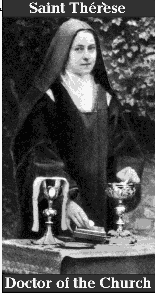
When Thérèse lived her short and intense spiritual journey, photography had just become an important new tool of self expression. We are fortunate, indeed, in possessing a number of snapshots that express different high points in her life. Among them is a moving picture of Thérèse behind a table, preparing the chalice and ciborium for Mass. It was taken in 1891 when, for a short period, she served as sacristan for her community. Thérèse enjoyed this task enormously, as her contemporaries have testified. But the photograph must have been of great significance to Thérèse.
She stands behind the table as if it were an altar. She holds a host in her hand as if she is a priest, ready to distribute Holy Communion. Thérèse who would ask for a priestly tonsure on her head during her final illness, could not but have imagined herself a priest at that moment. “If I were a priest, O Jesus, with what love would I give you to people!” (Story of a Soul, p. 187).
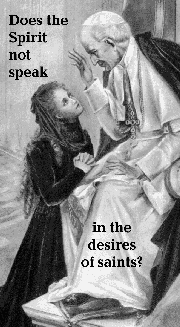
Another image from Thérèse’s life comes to mind in this context. As is well known, Thérèse applied for admission to the Carmelite Convent in 1887 in spite of her being only 14 years old. On pilgrimage to Rome, she met Pope Leo XIII on the 20th of November that same year. She put her request to the Holy Father himself. The scene has been wonderfully captured in a painting by her sister Céline in 1903. We see the young Thérèse trustfully kneeling at the side of the venerable old man, her hands tenderly folded on his right knee and her wide blue eyes looking up at the wizened features of the Pope. Their conversation is also very meaningful.
“My child”, the Pontiff said. “Do as your Superiors decide”.
“But, Most Holy Father”, Thérèse insisted, “if only you would say ‘yes’, everyone else would agree too.”
Leo XIII looked at her and said: “Come, come, your wish will be granted if God so wills”. While he raised his hand in benediction, two of the papal guard led her away in tears.
This image, of the saint imploring the Holy Father, is very symbolic to me. All the more so because the Pontiff’s diplomatic reply contained the prophetic statement: if God so wills. Her wish was, indeed, granted. Soon afterwards, Thérèse was admitted to the Carmel.
Catholic women who feel hurt because women are at present excluded from the priestly ministry by the official Church, may take heart from St.Thérèse of Lisieux. She was convinced that “God would never inspire me with desires which cannot be realised” ( Story of a Soul, p. 135). In her simple ‘little’ way, Thérèse stands out as a mighty prophet, challenging the conscience of Church leaders to re-examine the facts.
Moreover, Thérèse has now been formally declared a Doctor of the Church, someone who through her life and her writings taught the whole community of believers about faith and about what it means to be a follower of Jesus.
In Thérèse’s time the priestly ordination of women was utterly unthinkable. Yet, understanding Christ’s love, she imagined herself a priest and knew it was not Christ who discounted her but human circumstances. Catholic women today may nurture a similar hope in spite of official opposition. It is my considered opinion that the sensus fidelium, as a groundswell of ever growing spiritual awareness, will eventually overturn the official stand of the Church; as it has so often done in the past.
John Wijngaards
John Wijngaards
Please, credit this document
as published by www.womenpriests.org!