De Missa, book 5, chapter 15
[On the Mass, book 5, chapter 15]
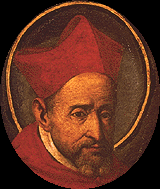
From De Controversiis Christianae Fidei by Robert Cardinal Bellarmine SJ, written between 1586 and 1593, re-published at Rome in 1840; here vol. III, p. 711.
Translated especially for womenpriests.org from the original Latin
by Dr. Mary Ann Rossi — credits
Paragraph numbering added to the text for easy reference.
Excerpts from Chapter 15
Mass is a Sacrifice
Bellarmine argues in this excerpt against the Protestant theologian Martin Chemnitz (1522-1586 AD) who stated that all the faithful have functions in the Eucharist and that all of them are ‘sacrificial’.
§ 1. … To explain away texts of the Fathers who assert Mass is a sacrifice, Chemnitz adduces six reasons:
- The first is that the Fathers speak of the alms that are given during Mass. For the people offered bread and wine, from which part was consecrated in the Eucharist, the rest given to the poor. And almsgiving is a kind of sacrifice.
- Secondly, that the Fathers spoke of the prayers which happend during the celebration of the Meal. For prayers are a kind of sacrifice.
- Thirdly, that the Fathers talk about the thanksgiving to which people are called in the celebration of the Meal, by considering God's gifts. Giving thanks also belongs to the sacrifice of praise.
- Fourthly, that the Fathers spoke of the preaching and the announcing of the death of the Lord which used to be joined to the celebration of the eucharistic Meal. For Paul (in Romans 15) calls the ministry of the Gospel a sacrifice.
- Fifthly, that the Fathers spoke of the various pious exercises that happen during the Meal of the Lord, acts of faith, repentance, hope and love, which are called spiritual offerings by Blessed Peter.
- Sixthly, that they Fathers spoke of the self offering of the faithful who during the action of the Meal dedicate themselves to God and consecrate their own body and soul. In Romans 12, Paul calls it a pleasing offering to God to present one's body in his service.
§ 2.
But all these reasons have no bearing on the matter at hand.
§ 3.
For when the Fathers speak about the oblation of the Eucharist they clearly say that only priests are allowed to offer this sacrifice to God. But alms, prayers, praises, and other things that Chemnitz laboriously enumerates, are offered by all the people.
§ 4.
Tertullian in his “on the Veiling of Virgins” says:
It is not permitted to women to speak in church, nor to teach, nor to baptize, nor to offer.
Likewise in his book on the exhortation on chastity, he says that the duty of the priest is to teach, to baptise, and to offer.
§ 5.
Epiphanius likewise (in Haeres 79) argues with many words that women are not allowed to offer sacrifices, and that even Christ himself did not permit his own mother to sacrifice, but only the Apostles, whom he had ordained priests.
§ 6.
The Council of Nicaea in canon 14. and Jerome in the Epistle to Evagrius, and other Councils, and the Fathers teach
passim
that Deacons do not have the power of offering sacrifice, but that it is the gift of priests.
§ 7.
But whoever has ever said that it was not allowed to deacons or to the laity or even to women to offer alms, orations, other ‘spiritual sacrifices’, which are only called ‘sacrifices’ improperly?
*******
De Notis Ecclesiae, book 4, chapter 9
‘On the Characteristics of the Church’, book 4, chapter 0
From De Controversiis Christianae Fidei by Robert Cardinal Bellarmine SJ, written between 1586 and 1593, re-published at Rome in 1840; here vol. II, p. 156.
Excerpt from Chapter 9
§ 10.
As Augustine says in his book
(de Haeres.
cap.27.): ‘The Peputian heretics give so much ruling power to women that women are also honored with the priesthood in this group’. Luther (in art. 13. of his opinions which Leo X condemned), that in the sacrament of Penance women and children can absolve equally as a bishop, or the Pope. And now, along the same lines, a woman is the head of the Church for the Calvinists in England.