This is a translation of a report entitled “Yes, I am a Catholic woman priest!” by Werner Ertel and Georg Motylewicz in Kirche Intern vol. 9 (1995) no 11, pp. 18-19. It was the first published account of her ordination to the priesthood.
Translated by Mary Dittrich and published on www.womenpriests.org with permission of the author and publisher.
Ludmila Javorová, 65, Vicar-General of the underground Czech Bishop Felix Davidek (d.1987) in Brno, declares publicly for the first time: “Yes, I am a Catholic priest!”
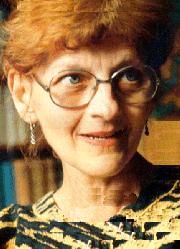
Stara Osada 23, a small flat on the ground floor of a concrete block in the mellowness of Brno, in the Czech Republic. High pressure over Central Europe means a warm blue sky over the capital of Moravia on this 13 October 1995. Ludmila is standing by her gas cooker in the kitchen, stirs the dill sauce, adds little semolina dumplings to it and garnishes it with a few sprigs of parsley, ready for the plate. The three of us stand around the table. A moment’s hush, and she blesses the meal, making the sign of the cross with her right hand as priests do. The conversation is in Czech, her mother tongue.
Georg, being a Pole and perfectly conversant with all East European languages, translates the essentials from time to time. He knows his way very well round the labyrinthine underground Church of Communist days, is in touch with bishops such as Blaha, Kratky, Zahradnik and repeatedly amazes Ludmila with details from the history of the persecuted Church. We are both eager to hear what the retired Vicar-General of Brno’s underground Bishop Davidek wishes to entrust us with, because this time she has invited us around to a personal interview, not like the time three years ago when we turned up at her home with a camera team, for the “Kompass” European magazine run by the Austrian Broadcasting Corporation ORF.
Ludmila serves hot black Nescafé with home made appelstrudel, and we move over into the living room, directly under a big portrait of Bishop Felix Davidek, who died in 1987. The slightly built, ascetic-like woman with reddish brown hair lights a candle and puts it on the little table. Her clear eyes behind glasses are alert, always a bit cautious, her voice is somewhat restrained, with a warm kindly timber.
Her ordination
Quietly she says that she has long prayed for this meeting, and that she sees in it a stroke of Providence, work of the Holy Spirit. She refers to our last meeting three years ago when, in connection with her activities in the underground Church, I asked her if she was an ordained priest. “Then as the camera was running, I evaded the question, because the matter was not meant for publication. But it kept on worrying me, which is why I invited you here today.” Ludmila, seated, closes the already not very wide open window till it is only just ajar, and draws the curtain a bit more.
“It was in 1970 that we summoned a Synod of the underground Church. One of the subjects was the ordination of women. We all had to promise Felix faithfully that we would keep absolute silence on the matter, indeed he demanded that in writing. One group was anxious not to discuss this theme at all; they more or less split off, and they were excommunicated by Davidek. Bishop Dubovsky did annul this excommunication, but up to now there has been no reconciliation with this group.”
“ But in our circle around Bishop Davidek the question of ordaining women continued to be discussed favourably, so that soon the first ordinations of women to the priesthood took place, including my own. One of the principal reasons for this was that in women’s prisons nuns and other inmates had died without priestly support or the sacraments. But it was also clear to us that a woman is much better at dealing with women’s problems than a man is. Just think of the sacrament of reconciliation.”
Ludmila moves into the present, and tells us that recently Czech television had shown a discussion between women and the spokesman of the Bishop’s Conference, Peter Fiala, during its “Arena” programme. A sociologist reproached Fiala, maintaining that celibate males can know nothing at all about women’s problems, whereupon he answered that he knew everything, because women came to confess to him too, telling all. “But it stands to reason”, commented Ludmila on this, “and the sociologist thought so too, that a women, badly treated by a man, is not going to confide all her misery and her problems to a male pastor.”
Her priestly ordination unfortunately met with mistrust on the part of her male colleagues in office. At Eucharistic celebrations, she says, she only concelebrated, and she was never the principal celebrant among male priests. But she is certain that women are suited to the priesthood, since Christ speaks to humanity through priests, irrespective of whether they are men or women. The telephone rings outside. Ludmila goes out for a moment.
Priestly vocation
Georg regrets that we are not getting concrete replies to our interposed questions on how her ordination as a woman priest took place in practice. Evidently Ludmila wants to keep a secret of the precise details of time, place, and ordaining bishop. She does not confirm conjectures that this could have been the Greek Catholic Bishop Krett, a member of the Basilian order, who ordained a number of women. As she told us later, she herself set forth the circumstances of her ordination in a letter to Pope John Paul II, to which she never received a reply.
The talk with Ludmila that afternoon in Brno is not like an interview. She wants to tell us something, wants to share with us the evidently most important phase of her life – and she lays down how far she wants to go. During our conversation it becomes increasingly clear what problems and difficulties Ludmila as a woman priest has – particularly – nowadays too. In effect she says she is rather lonely: people come to her, come to a church service and go away again. She cannot count on solidarity from her male colleagues, or on help from them. “On the surface they accept it, because they know that I am ordained, but internally they can’t cope with it. That’s the two thousand year old tradition of a male church, which can’t be changed overnight.”
Nevertheless, Ludmila is sure of herself and of her vocation to the priesthood. The children in her family were numerous, and at the age of fifteen she was already asking her father if she could become a priest. She felt the first person to understand her in this was Bishop Felix Davidek. who “tackled it properly as soon as he was released from his fifteen year imprisonment.”
And so the 1970 Synod was the firm foundation for ordaining women. The sun is by now very low in the sky. Ludmila draws the curtain closer. “Formerly we all had to sit on the floor when we aired the room” said Ludmila, remembering the era of the catacomb church. “I was always expecting arrest. The Secret Service knew too, about us women priests.” It is unlikely that the source of the leaks will be found. There are rumours that Sokol, now Bishop of Tyrnau, was an informant of the Secret Service. It is a fact, confirmed by Ludmila, that when investigating the matter of women priests, Sokol’s first question was about money: “How much did you earn from Mass offerings?”
More vocations
Ludmila knows names and addresses of other ordained women who now live in Slovakia. “I would like to get in touch with them”. One, at any rate, is working as a nurse in the Brno area. At the forthcoming Synod of the underground Church, early in November, she hopes to meet some of her women colleagues-in-office. For her work as Vicar-General and priest in the underground Church she gets neither thanks nor recognition, nor payment of any kind. So, in her mid sixties, she has to earn her living teaching in state schools. “Recently two girls in the school asked me spontaneously if they could become women priests. Both are from completely atheist families, which allows me to hope that the ordination of women will still be a subject for the next generation.” She regards herself as someone who has to offer her life in this cause: “In battle the first line always falls, so that the second line can get through.”
It is now late in Stara Osada. We accompany Ludmila to an evening dedication and opening of a youth centre in an outlying Brno parish, the one where three years ago she was allowed to celebrate the Liturgy of the Word. Nowadays Ludmila will no longer be allowed to stand at the altar “in full canonicals”, at least not at the altar of a parish church in which a man is the boss. Today she suffers the destiny of the underground Church exactly as when Communism prevailed: she must hide, must not admit to what she really is, may not officially exercise her true function. The only difference from past times, when she had to live in constant fear of arrest by the State Secret Service, is that the Vatican does not send agents to render her harmless. But should she receive any recognition in this life, that is more likely to come from the world of Western feminist theologians than from the Czech Republic, a country which tends to think it can put aside the confessors of the underground Church “like rubbish on the roadside” (Bishop Jan Blaha in Kirche Intern 10/95).
Read also:
- Report on a private visit of Ludmila Javorova to the USA, (1997)
- Interview with Ludmila Javorová (1999)
- Secret No More, story leading to publication of biography of Javorova, 2001.
- Ordained a Priest in the Catacombs, review of biography of Javorova, 2001.
- Woman Says First Mass in Secret, excerpts from biography of Javorova, 2001.
- Article in The Tablet(2003)
- Letter to www.womenpriests.org network (2007)
- Bishop Felix Davidek
- Visit our Czech language section
| ||||||
Six options for Catholic women who feel called to the priesthood? |
Please, credit this document
as published by www.womenpriests.org!