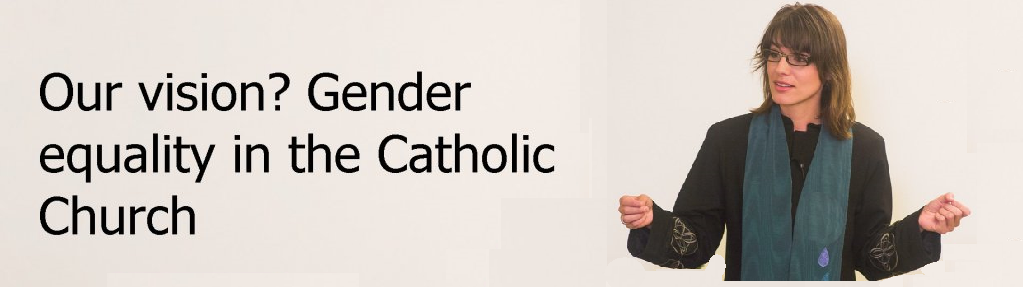
new International Ambassador
Therese Koturbash

‘Hope Has Two Beautiful Daughters: Their Names Are Anger and Courage’
My Story by Therese Koturbash
As a quiet faith-filled observant Catholic who appreciates the opportunity for daily mass, never in my wildest dreams or nightmares could I have imagined becoming a front line worker in the campaign for women priests.
A lawyer by profession today, during youthful career discernment struggles, I would often innocently pray for a figurative ‘St. Paul moment’ of being ‘knocked off my horse’ by the Holy Spirit so that when I ‘stood up’, future direction would be clear. St. Paul’s experience after all seemed like a tidy and efficient way for moving forward. Yet as life teaches, there are reasons for the sayings which urge caution about this sort of thing:
- Be careful what you wish for, or
- Pray then duck.
Years later during a pilgrimage to World Youth Days in Toronto 2002, the St. Paul moment with all its pain came for me. All my life, I have been fortunate to take for granted a Church of the Canadian prairies filled with the spiritual energy of Vatican II. At World Youth Days, I was awakened to the sight of an unfamiliar Church. The ‘fall’ or should I say ‘the reckoning’ bolted me into a painful awareness of discrimination against the women who are called by God to serve as priests. Though at one time I might have written off the women’s ordination movement as one of a rebellious rabble rousing kind, it suddenly dawned on me that the exclusion of women from sacred ministry was more than an issue about ‘equality’ (as important as that is) but also a matter of critical concern for all God’s people – women and men. As a faith community, we must be concerned about all priests called by God to serve us and our Church.
The World Youth Days’ experience literally did ‘knock me off my horse.’ I was disoriented, fearful, and enormously grieving for the circumstances that see so many vocations excluded from service to our Church just because those vocations happen to be planted in women. My once cherished daily mass became a time of painful tears. Though I tried to reach out for help about the stirrings inside, reactions from others were frequently negative. I felt as though I had been stricken with a disease or a spiritual cancer. I was fearful that ‘by talking’ I would spread what I perceived to be the contagion of the ‘virus’ or ‘infection’ which had inflicted this painful new vision of my Church. If I caused contagion to spread, I worried about the damage I would be responsible for inflicting on my community of faith.
 Though my parish priest tried to help, his efforts seemed more like pity or charity than they did an energy for ‘justice.’ This would feed my anger. I could not articulate even to myself why I found the Vatican’s theology to be so deeply insulting and hurtful. Against the theology of the icon which has been such a meaningful part of my life (I am a Ukrainian Catholic from the Byzantine rite of the Church)the Vatican sets men apart. When Rome says that:
- because I am a woman, I do not bear an iconic resemblance to Christ (Inter Insignores)
- because my spirit has been delivered in the biological packaging of a woman, in our sacraments a simple piece of bread or a machine cut wafer has greater capacity to be recognised as Christ
- while a man can stand in for the bride or groom, my ‘woman’ being imposes limitations on what ‘my package’ can represent
the realisation that throughout our history, inanimate objects like candle sticks and sacred cloth were more welcome at the altar than were women – because of the belief that we were unclean, impure, imperfect and misbegotten men and therefore forbidden from entering into sacred liturgical space — soon made it incomprehensible as to how I, a woman, could continue participating in this faith. The Christ I knew taught me to see his face in every person that I meet. The Christ I knew did not demand crawling over broken glass to participate in the mass.
Providentially coinciding with my attempt to discern whether the Church was still a place for me, I was chosen by our federal government to serve as one of five hundred Canadian Election Observers in Ukraine’s 2004 Third Round Presidential Election. It is remembered today as the historic Orange Revolution. Participating as an  Observer delivered more unexpected faith community revelations to me. While I had been contemplating a departure from the Church, the people of the Revolution taught me to see the value of working from within for change. The experience gave me some insight into the humility it takes to step up to the plate to work for change. I could see that though the transformations my Ukrainian ancestors (grandparents, aunts and uncles) yearned for did not come for them, they did eventually come for ‘the people’ of Ukraine. I saw how every person’s and each generation’s participation in the historic resistance were essential links in the chain that becomes the conduit for transformation. Suddenly I understood how redemption can be a process and that there is nothing wrong with this. And while previously I had perceived my newfound ‘struggles’ in the Church to be like a cancer or an infection, I found myself able to connect with the people camped out in Kjiv’s Independence Square. They weren’t rebellious rabble rousers. They weren’t gathering with signs and song because they hated Ukraine. They were there camped out in the cold because they loved Ukraine.
Besides a free and fair Ukrainian election happening that year, a parallel historic moment happened in the life of one obscure Canadian woman (ie, me) that year. ‘We are people made for our times’ means that we must have the courage to step up to the plate of the work we are called to do.
Ironically, the pope who imposed the gag order on dialogue about women’s ordination has become a source of inspiration for me. While trying to come to terms with the man-show that had come to town courtesy of Rome, during World Youth Days I would hear John Paul II’s frail Parkinson’s afflicted voice ‘booming’ as it was amplified through the loud speakers, ‘Be not afraid,’ and ‘Cast out into the deep.’
Summonsing my courage, I discerned that with my own frail voice, I too could speak.
 Hope has two beautiful daughters: their names are anger and courage. Anger that things are the way they are. Courage to make them the way they ought to be.
St Augustine
The Holy Spirit works in amazing ways. Shortly after appreciating insights gained during the Orange Revolution, I suddenly was appointed to be the Canadian Delegate to the International Steering Committee of Women’s Ordination Worldwide (WOW). In my first year of service to WOW, I was elected to serve on its four member Leadership Circle. I was recently re-elected to this position. Recently, I began a leave of absence from my twenty-one year career as a lawyer so that I could join the Team on the ‘front lines’ of the campaign at womenpriests.org.
In the near future, I will begin studies for a Master’s of Canon Law degree. It is significant to me personally that so much transformation is happening during what Rome has deemed to be the Year of the Priest. It is the Year of the Priest: not just those who happen to be admitted to the Roman sanctioned men’s club but the Year of all priests called by God – men… and the women not yet recognized by Rome.
I now give thanks for every painful step along the way. I see how the intensity of my experience has served to fuel my conviction that things must change. I see now that though my parish priest tried to help, in reality there was little that he could say. What words can defend a systemic discrimination propped up by an unorthodox theology that teaches in the source and summit of our faith, women are not icons of Christ?
Now part of the international campaign for women’s ordination enshrined in the work of the Wijngaards Institute, I hope that you will reflect on our work and the reasons for it. I hope that you will consider supporting our work for safeguarding the charisms of women for the service of the Church and for the justice that will come through the recognition and welcome of women priests called by God to serve our Church.
Therese Koturbash Ambassador for www.womenpriests.org
May 2009