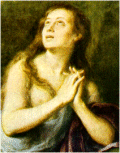
Saint Mary Magdalen
| Sr Theresia Saers explains: Mary Magdalen is, once more, very popular in our time. It is not difficult to see why. She captures the imagination. She offers women a model of feminine discipleship and ministry. On this web site, in the context of our reflection on the ordination of women, we will focus especially on Mary’s function as a heroic counter figure, as someone who in popular Catholic imagination showed what a woman’s role could be like, if it were not for prevailing masculine domination. The figure of Mary Magdalen assumed different roles in different times. We will here trace the main features in Christian history. See below the many documents on Mary Magdalen published on our website. Visit our “honour” page to see a tribute to Theresia. | The existence of such a challenge to the existing male culture is extremely significant because it arose from the deep conviction among Catholics that women were worth so much more than what they were credited with in the official Church. The devotion to Mary Magdalen has been a clear manifestation of the latent tradition in the hearts of Catholics that knew women, as much as men, were called to full participation in the ministries. |
HeadingsPopular reconstructions of her life Mary and the Fathers of the Church | |
The historical Mary Magdalen
| The Gospels mention three women who played a role in Jesus’ life: * Mary of Magdala, who was a disciple of Jesus, who was present at the crucifixion and who visited the empty tomb. * Mary who lived in Bethany, sister of Lazarus and Martha. She listened to Jesus’ teaching and anointed his feet with ointment two days before his Passion. * the repentant woman in Simon’s house (Lk 7,36-50). Authors are divided on the question whether these women were, in fact, identical, with different strands of oral tradition retaining various aspects of the same woman disciple. But Christian imagination took a firm line. In the course of time, perhaps under influence of Gregory the Great’s writings, the two Marys and the repentant woman were assumed to be one and the same person: St. Mary Magdalen. In later tradition, the three personalities simply became one. A discussion of the identity question can be found in One Mary, Two or Three? | Professor Esther de Boer is an international expert on Magdalene studies. Read her assessment on “the possibility of a historical reconstruction of Mary Magdalene“. Read also a synopsis of her book “Did He love her more than us?” Read the Gospel texts for yourself. |
Popular reconstructions of Mary Magdalen’s life
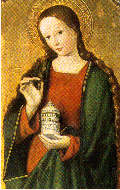
 Mary Magdalen continues to inspire Christians today. This has given rise to meditative biographies. * A spiritual reconstruction of Mary Magdalen’s life can be found in | For unusual views on the historical Marys, see: * Mary of Magdala was the Beloved Disciple and was the real author of the Fourth Gospel (Ramon Jusino); * Mary of Bethany was a priest, and even a bishop, a ´keeper of tradition’, ordained by Jesus (Thomas W. Butler). |
Mary Magdalen and the Gnostics
 In some Gnostic sects of the 2nd to the 5th centuries AD, Mary Magdalen played a large symbolic role. She was credited with having been close to Jesus and with having received special revelations from him which she passed on to the apostles. Mary Magdalen was the model of the priestly ministry of women. | Read: * a summary of gnostic texts describing Mary Magdalen; * an excerpt from the Gospel of Mary. * Read also: What became of God the Mother? Conflicting Images of God in Early Christianity, by Elaine Pagels. * Review of Margaret Starbird’s The Goddess in the Gospel. |
Mary Magdalen and the Fathers of the Church
 The Fathers of the Church presented Mary Magdalen as a model disciple and an important witness to the risen Lord. We find her praised by Tertullian, Hippolitus, Origen, Dionysius, Pseudo-Clement, Ambrose, Augustine and Gregory the Great. Gregory of Antioch gave this as Jesus’ message to women: ‘Announce to my disciples the mysteries you have seen. Be the first teacher of the teachers. Peter who has denied me, must learn that I can also choose women to be my apostles.’ | Read: * fragment from the Gospel according to Peter; * Mary meets Jesus by St. Augustine; |
Mary Magdalen in the Middle Ages
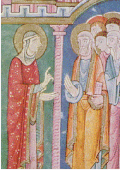
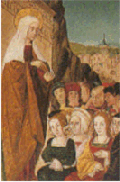 It is especially in the Middle Ages that St Mary Magdalen functioned as a ‘counter-heroine’ amidst an oppressive male culture. She was admired * as a woman who was the first witness of the resurrection; * as a woman who had taught the apostles the truth when they went astray; * as a woman who preached – when women were forbidden to preach; * as a woman who defied male opposition. Devotion to Mary soared. We find her on statues, paintings, friezes, altar panels and manuscript illustrations. Usually she is presented either as receiving her commission from Christ, as reading Scripture or as preaching to townsfolk. A twelfth-century Psalter of St. Albans in England shows her addressing the assembled apostles who respectfully listen to her, their heads bowed. She obviously functioned as an expression of people’s deep conviction that a woman could share the full priestly ministry. | Read the Life of Mary Magdalen in the 13th-century Legenda Aurea. This was a very influential text. See also The Conversion of blessed Mary Magdalene. The devotion to Mary Magdalen was also important to the Order of Dominicans, founded in the 13th century. Read Mary Magdalene – The Apostle of the Apostles and The Order of Preachers, by Guy Bedouelle, OP. Visit also the series of Picture Meditations on Mary Magdalen. |
Mary Magdalen and art
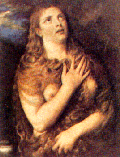 * *For the convenience of students of her devotion, we have assembled a survey of paintings of the saint which are accessible on line. They can be found here: Mary Magdalene in European art. * The meaning of this art for our study can be seen in the Picture Meditations on Mary Magdalen. We join Christians who, for many centuries, meditated on Mary of Magdala and venerated in her the image of a truly liberated woman, a disciple of Christ who was able to do what social convention and Church law forbade. At the hand of old paintings and illustrations Theresia Saers reflects on possible implications for us. | A typical example of European art involving Mary Magdalen can be seen in the capital sculpture of the Basilica of St. Andoche (12th century). Read Romanesque capitals and the Bible. |
Bibliography on Mary MagdalenTheresia herself has written much more. Visit our “honour” page to see a tribute to Theresia. | |